Transmission & Distribution
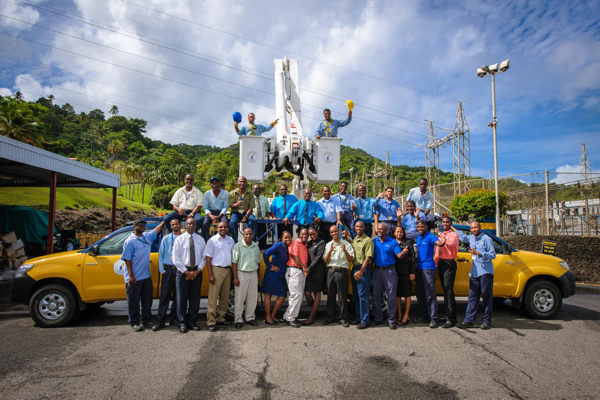 The Transmission & Distribution Department is responsible for the overall management of the Transmission & Distribution system. This includes the design, erection, operation, maintenance and security of all facilities used to transmit, distribute and supply electricity to individual customers. This includes all poles, lines, transformers and substations.
There are 7 substations, located at:
- Cul De Sac
- Castries
- Union
- Reduit
- Soufriere
- Vieux Fort
- Praslin
The Department comprises five major sections: Inspection & Maintenance, Substation Maintenance, Metering, Customer Care, and Construction.
Transmission voltage is 66kV across 73.32 miles of transmission lines. Distribution voltage is 11kV across 2,566 miles of distribution lines. Customers are supplied at 240V Single Phase, and 415V three phase.
The Department has a regular and strict maintenance regime that ensures that the transmission and distribution infrastructure functions optimally and is robust enough to deliver power that is safe, reliable and of the highest power quality.
Some recent initiatives aimed at upgrading the transmission and distribution infrastructure, improving reliability and reducing system losses, include the introduction and roll out of an advanced metering infrastructure (AMI), the upgrading of low and high voltage conductors on the system, more optimal loading of transformers, and increasing proficiency in live line work. The AMI project includes the replacement of electro-mechanical meters with ‘smart meters’ that will allow for the introduction of such services as automated meter reading, remote disconnections and re-connections and pre-paid metering.
A lot of work has also gone into expanding the Distribution Automation programme which includes the deployment of auto reclosers and remotely controlled switches. This allows the System Control Department to remotely reconfigure the system when faults occur, significantly reducing the length of outages, fault finding and response times.
The Department is currently engaged in some pilot projects to assess the impact of using various types of energy efficient street lighting in order to make decisions for the future.